Exhibition 1956
A journey spanning thousands of years of a wandering people across the globe finds a point of convergence in a solo exhibition in Manhattan.
Exhibition 1956 is a solo exhibition by Israeli artist Eli Gross, presented in Manhattan in March 2026 and visited by hundreds of attendees.
The exhibition brings together a large body of works by Gross, including the central piece The Menorah of Hope, the memorial installation From Ruin to Renewal, The Mezuzah of Hope, and dozens of additional works created from materials that carry stories from across the world and from different historical periods.
Through sculpture and installation, Gross transforms fragments of reality into a unified visual language that connects past and present, destruction and renewal, exile and belonging.
About the Exhibition
Artist Eli Gross presents a personal and collective journey that begins in a Hasidic family in Jerusalem, continues through reserve military service during Israel’s recent war, and evolves into a full artistic practice centered on material, memory, and meaning.
At the heart of the exhibition stands The Menorah of Hope, first presented at Hostages Square in Tel Aviv and later exhibited in Manhattan. Around it unfolds a wider body of work constructed from missile fragments, metals, earth, and found objects, each carrying a physical and symbolic history.
The exhibition explores identity, memory, survival, and continuity. Materials are not neutral, they function as witnesses. Each object holds a story, and each work becomes a point of encounter between personal narrative and collective history.
Participating Artists
Alongside the works of Eli Gross, the exhibition featured five Israeli artists, not as external participants, but as part of a close circle of friends, collaborators, and family, each connected to the work through shared experience and ongoing relationships:
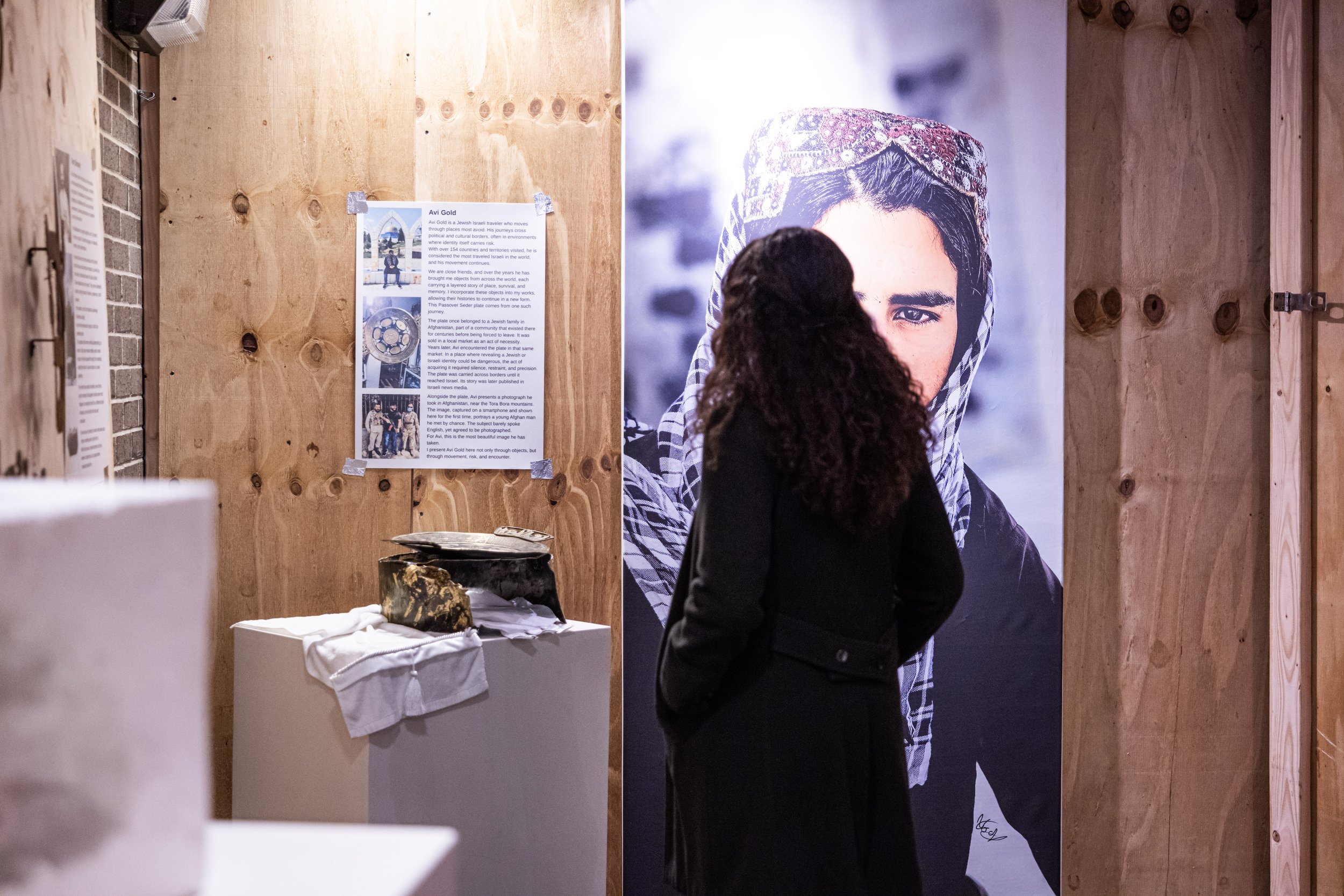
Avi Gold
A close friend of Gross. His work moves through regions often avoided, crossing political and cultural boundaries. The objects and images he brings carry traces of movement, risk, and encounter, forming layered narratives of identity and survival.
Moshe Tarka
A long time collaborator. Gross and Tarka work together on joint projects, sharing processes and material exploration. Tarka’s work reveals figures embedded within layers through carving and excavation, reflecting a search for truth and presence.
Tom Shmuely
A working partner in ongoing projects. Together with Gross, he engages in material based practices rooted in metal and transformation. His works treat metal as a living surface shaped by time, exposure, and environment, holding tension between destruction and endurance.
Ahuva Gross
The artist’s mother. Her work emerges from a life rooted in family, tradition, and continuous creation. Her presence introduces a generational dimension in which artistic practice is inseparable from daily life.
Lt. Col. Isaac T.
Gross’s commanding officer during military service. His inclusion reflects a different dimension of the same reality, one shaped by responsibility, decision making under pressure, and clarity within complex systems.
Together, these artists form a living network rather than a formal group, where personal relationships, shared work, and lived experience converge into a unified narrative.
Artistic Interpretation
At its core, Exhibition 1956 is not only a presentation of objects, but a constructed environment where material becomes language.
Fragments of missiles, industrial metals, and organic elements are removed from their original context and reassembled into forms that carry new meaning. What was once associated with destruction is repositioned as a vessel of memory, continuity, and hope.
The works operate across multiple layers:
Historical: materials connected to real events and geographies
Personal: biography, relationships, and lived experience
Collective: a broader narrative of movement, exile, and return
Rather than separating past and present, the exhibition collapses them into a shared space. The viewer does not observe history from a distance, but encounters it through physical presence.
Future Exhibitions
The exhibition is planned to be presented in additional locations across the United States.
Communities, institutions, and galleries interested in hosting the exhibition are invited to submit proposals via email:
Please include contact details and information about the proposed venue.
Shipping and installation costs are to be covered by the hosting community.
Gallery